Friday, August 21, 2015

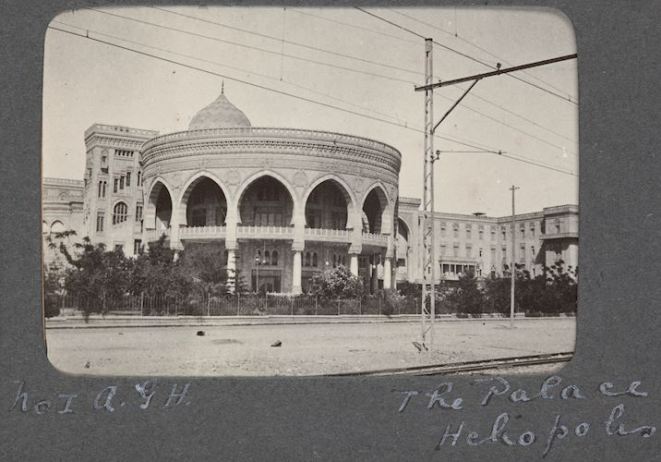
Grand Hotel Heliopolis Palace, Cairo

By Mark David (mark-david.com)
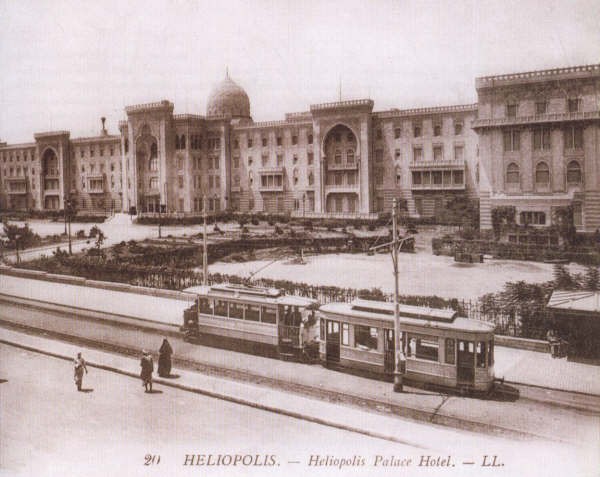
The grand Heliopolis Palace Hotel was built in 1910, refuted to be the most luxurious hotel of the time in Africa and the Middle East. With its architectural emminence the Heliopolis Palace Hotel became a travel destination for many, including foreign royals and international business tycoons. The hotel was designed by Belgian architect Ernest Jaspar, using the services of architect Alexandre Marcel to design the central dome using the local Heliopolis style of architecture, a synthesis of Persian, Moorish Revival, Islamic, and European Neoclassical architecture that became known as the Heliopolis style.
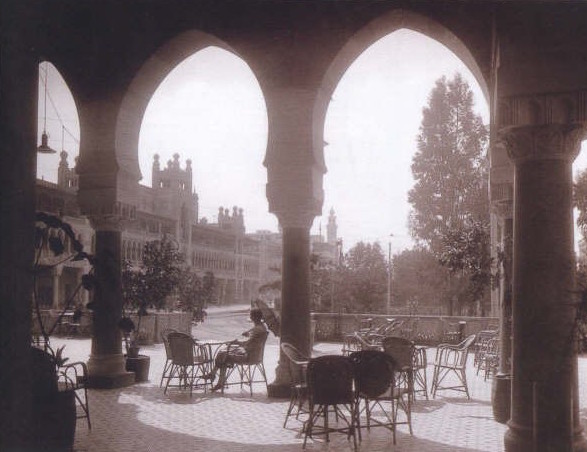
Heliopolis_Palace_Hotel_5_(2)
In its time, the luxurious Heliopolis Palace Hotel exceeded in service and elegance such great Cairo hotels as Shephard's (no longer existing) and the Continental (existing but not operational) both overlooking the Azbakia gardens and Opera square, as well as Mena House Hotel at the foot of the pyramids and the Semiramis Hotel (non-existent but replaced by a new tower and management). 

But none of those hotels was labelled “palace” like the Heliopolis Palace Hotel. And while all had celebrities of all sorts and heads of states reside in them, the Heliopolis Palace Hotel was the only one that changed functions during World Wars. 

The hotel was built by the contracting firms Leon Rolin & Co. and Padova, Dentamaro & Ferro, the two largest civil contractors in Egypt then. Siemens & Schuepert of Berlin fitted the hotel’s web of electric cables and installations. The utilities were to the most modern standards of their day. The hotel operations were under French administered management.
The Heliopolis architectural style, responsible for many wonderful original buildings in Heliopolis, was exceptionally expressed in the Heliopolis Palace Hotel’s exterior and interior design. The hotel had 400 rooms, including 55 private apartments. Beyond the Moorish Revival reception hall two public rooms were lavishly decorated. Beyond those was the Central Hall, the primary public dining space with a classic symmetrical and elegant beauty.
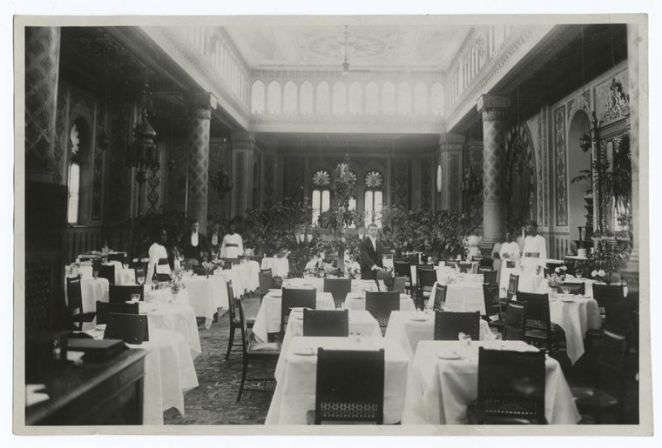
Heliopolis_Diningroom
Heliopolis_Palace_Hotel_1

Description

The Central Hall’s dome, awe inspiring to guests, measured 55 metres (180 ft) from floor to ceiling. The 589 square metres (6,340 sq ft) hall’s architectural interior was designed by Alexander Marcel of the French Institute, and decorated by Georges-Louis Claude. Twenty-two Italian marble columns circled the parquet floor up to the elaborate ceilings. The hall was carpeted with fine Persian carpets and had large mirrored wall panels and a substantial marble fireplace. To one side of the Central Hal was the Grillroom seating 150 guests, and to the other was the billiards hall, with two full-sized British Thurston billiard tables and a ‘priceless’ French one. The private banquet halls were quite large and elaborate.

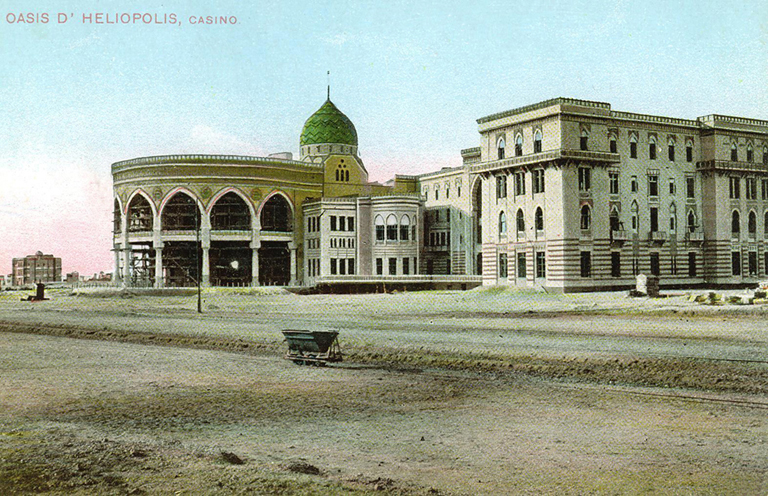
One of the main features of the original design is a half-round building feature in the middle of the rear elevation on the same axis as the entrance portal and the dome. It once functioned as a golden age banquet hall but was originally intended to be a casino to entertain the citizens of the remote Heliopolis “oasis.” 

The Interior

Photos of this banquet hall’s interior are rare. The mahogany furniture was ordered from Maple’s of London. Damascus-made ‘East Orient style’ lamps, lanterns, and chandeliers hung throughout, suspended like stalactite pendants. The upper gallery contained oak-paneled reading and card rooms furnished by Krieger of Paris. The basement and staff areas were so large that a narrow gauge railway was installed running the length of the hotel, passing by offices, kitchens, pantries, refrigerators, storerooms and the staff mess. Notable is the replacement of the traditional original parquet with marble in an arabesque pattern. 


Echoes of the War: A Base Hospital


HeliopolisHotel3
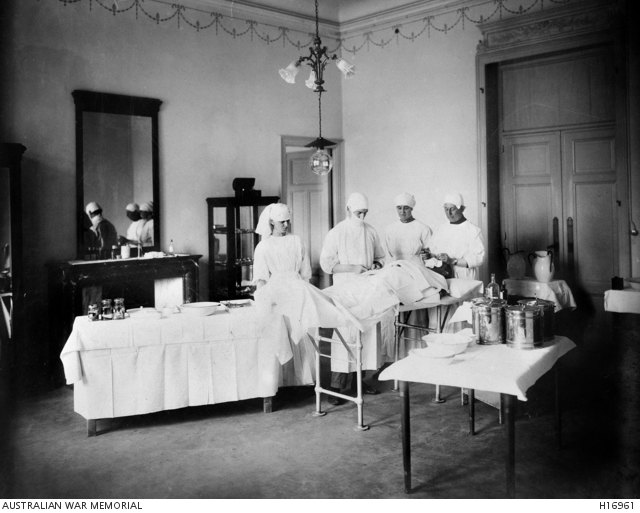
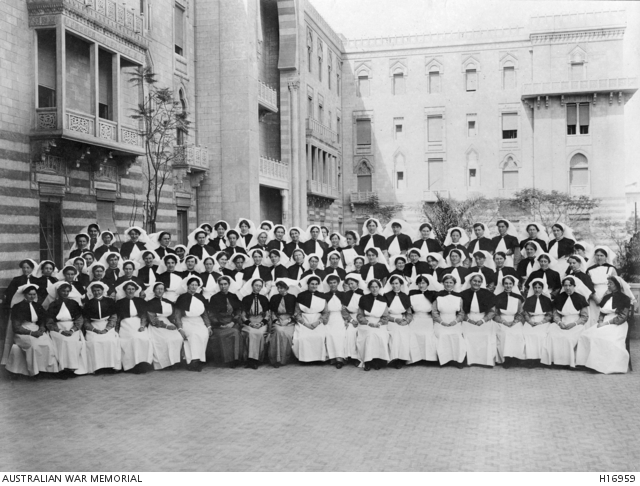
The First Australian General Hospital is installed in the magnificent premises of the Heliopolis Palace Hotel. The building is said to be the most gorgeous hotel building in the whole world, but to day it is filled with the manifold activities of a great general hospital. The figures themselves are large, accommodation for 1,000 sick, but when you pass along corridor after corridor, every door opening on the neat white beds in every room, when you find the grand dining-hall converted into a great convalescent ward with 100 beds, then you begin to understand something of this great institution, filled alas, to-day with the flotsam of youth being prepared for war. For there are no wounded in our 600 sick, only the toll being paid to pneumonia, rheumatism, influenza, and the obscure diseases of this Eastern land. No, it is not a hotel to-day, for grey-robed nursing sisters from Australia move quietly around, cheerfully doing heroic service, and khaki-clad orderlies carrying stretchers or filling their multitudinous duties, pass along the halls and passages. Truly motors constantly come and go, at the front entrance, but they are painted white or grey with the big red cross on sides and top, and their passengers more frequently than not are carried up the marble steps into the spacious entrance hall. And sometimes, alas, the slow march of troops is heard, and the tramp of horses’ feet, the grinding of the wheels of the gun-carriage, for a party of men have come to take away, and pay last honours to the comrade who has died. Within these walls great fights have been, are being fought, medical skill and attention beyond all praise, nursing that fails not, day or night, against the disease that would destroy. Great victories have been won. A haggard man will tell you that he has lost a month of memory. A few months will fill again the wasted cheeks, and build again the muscular limbs, but that lost month of his was spent by nurses and medical officer in an apparently hopeless war against pneumonia and typhoid combined. Again and again defeat seemed inevitable, but the Australian nurses nursed to the last, and victory was snatched, out of apparent defeat. Peace hath victories more wonderful than war. But there are sad things here — too sad for words. Let all who in the Homeland are mourning their dead lying in Egyptian graves know this — that nothing can surpass the tenderness and care with which our Australian women ease the last moments of our boys who die here.
1915 ‘Echoes of the War.’, Spectator and Methodist Chronicle (Melbourne, Vic. : 1914 – 1918), 18 June, p. 882, viewed 13 September, 2014, http://nla.gov.au/nla.news-article154169500
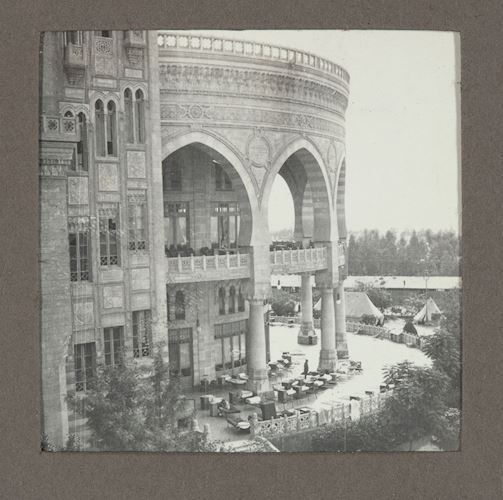
HeliopolisHotel2
The unit left Australia as a General Hospital of 520 beds. In Egypt, during 1916, the establishment was increased to 750 beds and later, in France, in 1916, it was increased to 1040 beds.
The staff and equipment embarked on board the S. S. “Kyarra” along with four other Medical Units of the A. I. F. viz : N° 2 Australian General Hospital, N°s 1 & 2 Aust. Stationary Hospitals and N° 1 Australian Casualty Clearing Station, and sailed for Egypt on 2ist November 1914.
HeliopolisHotel4
Arriving in Egypt on January 14th 1915, the 1st A. G. H. wns accomodated in a building and tents at Heliopolis, a suburb of Cairo. The building was very large and palatial, and is well known as the Heliopolis Palace Hotel. On January 24th 1915 the Hospital was opened for the reception of patients. The patients received consisted of all ranks of the A.I.F., and all classes of cases were treated. After a short period, and owing to circumstances, the hospital took over other additional premises for the treatment of different classes of cases. Amongst such were Aerodrome; The Luna Park; The Atelier; The Sporting Club buildings and grounds at Heliopolis, and The Artillery Barracks at Abbassia Depots, and they were attached to and within the command of the 1st A. G. H. Subsequently, however, all of these Auxiliaries, with the exception of the Aerodrome which was closed in April 1915, were made into separate A. A. M. C., A. I. F. units, each with its own personnel and equipment. They became respectively the N° 1, N° 2, N° 3 and N° 4. Australian Auxiliary Hospitals in Egypt, each of which has a history of its own.
HeliopolisHotel1
The 1st A.G.H. had a most useful career from fourteen to fifteen months in the land of the Pharoahs, having served there from January 1915 to March 1916. During that period the hospital attended to its full share of patients from A.I.F. troops serving in Egypt, also its share of. Australian sick and wounded soldiers who had served in the Gallipoli Expedition in 1915.
In March 1916, following upon the decision that the A.I.F. should serve in France, the various A.A.M.C. units were ordered to close and pack up, their patients being transferred to the Auxiliary and other Hospitals.
The 1st A.G.H., after a hurried departure from Heliopolis, with personnel and equipment for an establishment of 750 beds, embarked at Alexandria on 29th march 1916 upon H.M. Hospital Ship “Salta”. This vessel has since been sunk by enemy action.
Arriving at Marseilles on April 5th the unit disembarked, and after a few days waiting for orders, proceeded by rail and arrived at Rouen on April 13th 1916; and the hospital was opened for the reception of patients on April 29th 1916. The 1st A.G. H. has thus been receiving patients in France for considerably over two years. The patients received have been from all ranks (except officers) of the British Armies in France viz : English, Irish, Scotch. Welsh, South African, Canadian, New Zealand, and our own Australian soldiers, etc. No distinction are made. Recently some U.S.A. soldiers of the American Expeditionary Force have also been received. All the patients are treated equally conscientiously and well, and it is a privilege, an honour and a pleasure to be able to do anything to help them in the great cause in which we are all engaged.
Following the cessation of hostilities on Nov. 11, the hospital ceased to receive patients in France on Nov. 30 1918 preparatory to its transfer to reopen at Sutton Veney near Warminster, England.
The 1st A. G. H. is now in the fifth year of its Active Service and there are very few of the original members amongst its personnel at present. Many changes have taken place owing to the original members and many of their successors having been transferred to other A. A. M. C. units. Several have gone home. Some have been invalided to Australia, and some have “Gone west”.
J. A. D.
The Jackass, Christmas 1918

Recent History


The Heliopolis Palace Hotel is today called the Ittihadiya Presidential Palace. 
In 1958 it was purchased from its original owners by the state which who considered converting it into a municipality of Cairo administration building. The plans fell through as the political leadership under President Gamal Abdel-Nasser preferred a more fitting location on the banks of the Nile in front of the Egyptian Museum. 

In 1972 a new function was assigned to the Heliopolis Palace, becoming the headquarters of the Arab United Republic which united Egypt, Syria and Libya. And hence the name Ittihadiya (Arabic translation for Union) and Uruba Palace (Arabic translation for Arabism). 


Ever since, Ittihadiya has been the office of all the presidents of Egypt, a function that transformed the Heliopolis Palace into a presidential palace.

Thursday, August 13, 2015

The Kore Kosmou


Mark David's  homepage


In Heaven the gods dwell with the Architect of all, in the Aether are the stars and the sun, in the Air are souls and the moon, and on Earth are men and living things...

A Greek text called the Kore Kosmou (“The Virgin of the Cosmos") ascribed to Hermes Trismegistus (the name given by the Greeks to the Egyptian god Thoth), names the four elements fire, water, air, and earth.

One of the most famous of all alchemical axioms is ‘as above, so below’ – meaning always that in every small part of reality there is a tiny reflection of the great ‘over-structure’ of reality. And, in the largest structures, are hidden secrets of the smallest. And vice versa.

This is represented pictorially by the 16th-17th century Rosicrucian and Kabbalist, Robert Fludd, in his Utriusque Cosmi Historia (1617) and by Fludd’s contemporary, the alchemist, Johann Daniel Mylius, in the Opus Medico-Chymicum (1618). 


The Kore Kosmou


' And Isis answer made: Of living things, my son, some are made friends with fire, and some with water, some with air, and some with earth, and some with two or three of these, and some with all. And, on the contrary, again some are made enemies of fire, and some of water, some of earth, and some of air, and some of two of them, and some of three, and some of all. For instance, son, the locust and all flies flee fire; the eagle and the hawk and all high-flying birds flee water; fish, air and earth; the snake avoids the open air. Whereas snakes and all creeping things love earth; all swimming things love water; winged things, air, of which they are the citizens; while those that fly still higher love the fire and have the habitat near it. Not that some of the animals as well do not love fire; for instance salamanders, for they even have their homes in it. It is because one or another of the elements doth form their bodies' outer envelope. Each soul, accordingly, while it is in its body is weighted and constricted by these four.'

The most essential notions that we see here are creation by the word, the gods acting under the command of a supreme God, the function of created souls to keep nature circulating, the body a prison of the soul, the heavenly types of animals preceding the earthly creation, and the mission of gods on earth.

Besides the Egyptian ideas already mentioned, Greek influence is seen in the characters of gods and in the episode of the earth spirit, and probably Indian influence in the Metempsychosis and the fire-sacrifice of spices, as by Apollonios. There is throughout this cosmology a vigorous and eventful chain of thought, entirely different to the maundering of later writers.

The ideas of this sermon are that the souls of men and animals are all alike, and Metempsychosis is assumed between human and animal bodies; the soul is individual, the work of God's hands and mind; its congress with the body is a concord wrought by God's necessity; at death it returns to its proper region. The reign of souls is between the moon and earth, for above the moon are the gods and stars and providence; the souls pass through air and wind without friction; their reign is divided into the four quarters of earth, higher the eight winds, higher sixteen spaces of subtler air, and highest thirty-two spaces of subtlest air; these are called zones, firmaments, or strata. The kingly souls occupy the highest, and so in order down to the base souls the lowest. There is a warder of souls, and a conductor to and from the bodies. Bodies are a blend of the four elements, each affecting the character.

First published in 1908, the Kybalion: A Study of The Hermetic Philosophy of Ancient Egypt and Greece is a hermetic and pseudo-psychological mish-mash. Authorship is merely and mys-teriously attributed to “Three Initiates” who claim to convey to readers, in concise terms, the philosophy of the legendary wellspring of alchemy, Hermes Trismegistus. The treatise touches upon several points that resonate with historic occult currents such as nothing ever ‘merely happens’; that there is no such thing as Chance; that while there are various planes of Cause and Effect, the higher dominating the lower planes, still nothing ever entirely escapes the Law. The Hermetists understand the art and methods of rising above the ordinary plane of Cause and Effect, to a certain degree, and by mentally rising to a higher plane they become Causers instead of Effects.

The masses (of people) are carried along, obedient to environment; the wills and desires of others stronger than themselves; heredity; suggestion; and other outward causes moving them about like pawns on the Chessboard of Life. But the Masters, rising to the plane above, dominate their moods, characters, qualities, and powers, as well as the environment surrounding them, and become Movers instead of pawns. They help to PLAY THE GAME OF LIFE, instead of being played and moved about by other wills and environment. They USE the Principle instead of being its tools. The Masters obey the Causation of the higher planes, but they help to RULE on their own plane. In this statement there is condensed a wealth of Hermetic knowledge – let him read who can.”


Link to translation of text:

Links to The Elements posts:


Wednesday, July 8, 2015

Texts of the 20th Century: Part 1

Texts of old


Note: the following is a copy of original writing not my own, part of a research process writing the fiction series, The Elements

THE PREHISTORIC GREEKS
THEOSOPHY, Vol. 27, No. 3, January, 1939 (Pages 99-105) 

On a blustery February afternoon in 1874 the German-American archaeologist Heinrich Schliemann climbed the hard steep road leading to the Cyclopean citadel of Mycenae, in the northeastern corner of the Peloponnesian peninsula. As he gazed upward at the grim outlines of the ancient fortress, sharply etched against the dull grey sky, his heart beat high with anticipation, for he knew that he was approaching the scene of one of the greatest tragedies of the heroic age of Greece. For in that citadel Agamemnon, after his return from the Trojan War, was slain by his wife Clytemnestra, who in turn was murdered by her children, Orestes and Electra.
Professor Schliemann had already begun to suspect that the stories of the Trojan War were limned upon an Atlantean background. While excavating in Troy he had found, in the treasure house of Priam, an exquisitely wrought bronze vase bearing the inscription: From King Chronos of Atlantis. Ten years later, while wandering through the Louvre in Paris, he came across its mate, which had come to light in Tiahuanaca, on the South American continent. If, before he died in 1890, this intuitive man had been fortunate enough to read Isis Unveiled and The Secret Doctrine, he might have learned that the Trojan War coincided with the cycle of events described in the Mahabharata, and that Homer's Iliad was but a copy of the Ramayana.
Homer declared that Agamemnon and Clytemnestra had lived in Mycenae, and, according to Pausanius, they were buried there. Armed with this information, Schliemann began his excavations. In the hillside tombs he found a number of skeletons wearing golden crowns, masks and girdles, and a vast treasure house filled with golden ornaments which, he believed, had once adorned fair Helen of Troy.
Scholars who had previously regarded the Iliad as a fairy tale now began to wonder if it could possibly be a record of some prehistoric race. When the Cyclopean fortress of Tiryns was excavated by Schliemann, Professor Sayce of Oxford suggested that the word Tiryns came from some pre-Aryan language spoken in the peninsula before the Greeks arrived.
The Greeks themselves called these prehistoric settlers Pelasgians. But who were the Pelasgians? Were they primitive Neolithic men, or did they belong to some mighty civilization of which the very name has been forgotten? What sort of people built the magnificent Lion Gate of Mycenae, with an enormous slab, weighing a hundred tons, poised a full twenty feet above the level of the ground? Who laid out the great hillside tombs of Mycenae, with their 45-foot domes built without a keystone? Professor Schliemann was convinced that "the architects who planned Mycenae and Tiryns certainly possessed an engineering and calculating skill which was not surpassed by the builders of the Pyramids."
The excavations of Sir Arthur Evans in Crete proved that these early settlers belonged to a highly cultured race. They had built a road across the island upon which they travelled in wheeled chariots. Their palaces were equipped with bath-rooms, running water, drainage systems, heating devices, and even elevators! Their artificers in ivory and bronze "wrought masterpieces which remain today among the world's greatest works of art." (Breasted, The Conquest of Civilization.)
Who were these mighty builders? Pausanius said that "the walls of Tiryns were built by the Cyclopes," and Euripides called the plain of Argos the "Cyclopean land." The identity of the Cyclopes is shrouded in mystery. One might expect the Greeks would themselves have left a record of their forefathers. They did, but in a form unacceptable to modern scholars. The Greeks preserved the record of the races which preceded them in their myths.
The word myth in Greek means an oral tradition, one which was passed from generation to generation by word of mouth. Plato considered the myths as "vehicles of great truths well worth the seeking." Even Ruskin declared that "to the mean person the myth always meant little; to the noble person, much."
We of the present day are content to accept a monkey as our ancestor, but the proud Greeks traced their lineage to the Gods. These gods were divided into three distinct classes: the Immortals, who dwelt on Mount Olympus; the inferior gods, who animated Nature; and the demi-gods, half mortal and half immortal. Here we have the three lines of evolution -- Monadic, physical, and intellectual.
The Gods of Olympus may be regarded in seven different ways. The meaning of the myths depends on the personification of the gods, which may be any of the following: of the noumena of the intelligent Powers of nature; of Cosmic Forces; of celestial bodies; of self-conscious gods; of psychic and spiritual powers; of Divine Kings on earth; and finally, as actual historical characters. If the Greek myths are interpreted from this last point of view, we will have a picture of the four races which preceded our own.
The Greeks allegorized the four Races as four Ages, using the four metals -- gold, silver, bronze and iron -- to symbolize the steps of descent into materiality.
The Golden Age was the period when the First Race lived in the "Sacred Imperishable Land" which capped the North Pole. The forms of this Race were ethereal. They could walk, run, fly, and see objects at a distance. They were sexless and the principle of Kama had not yet been developed. Thus it was said that in the Golden Age war was unknown and no one coveted the possessions of another.

The Second Race lived in the Age of Silver and occupied the Hyperborean Continent. The Greeks called it the "land of the gods," for it was the favorite abode of Apollo, the god of light, and its inhabitants were his beloved priests. The story of this Race is contained in the myth of Uranos, the King of the Second Continent. He personified the creative forces of nature, while his wife Gaea represented matter, the basis of all forms. According to the legend, Uranos produced giants and nymphs from drops of his own blood, suggesting the method of reproduction in this Race. He is said to have devoured his own children and to have been devoured by his son, indicating the fruitless efforts of unaided nature to create real men of mind.
The Third Race, of the Age of Bronze, inhabited Lemuria. This Race was itself divided into three periods. The early Lemurians were sexless, producing their young by exuding drops of vital fluid, which formed an egg-shaped ball. The myth of Leda, whose twin sons were gestated in an egg, refers to this early method of procreation. Then came a cycle of bisexuality. Plato gives us a description of the Third Race at this point of its evolution. "Our nature of old," he wrote, "was not the same as it now is. It was then androgynous. Our bodies were round, and the manner of their running was circular. Hence Zeus divided them into two." Finally mankind became male and female, and since that time the reincarnating Ego has depended upon the union of the sexes for the production of its physical vehicle.
At the beginning of the Fourth Round on this globe, every class of being was one-eyed. The "one-eyed Cyclops" of Greek mythology, those giants fabled as sons of Coelus and Terra, three in number, represented the last three sub-races of the Lemurians, for the two front eyes, as physical organs, did not appear until the beginning of the Fourth Race. The myth of Ulysses, who visited the cave of the Cyclops Polyphemus and destroyed his vision by means of a fire-brand, symbolizes the atrophy of the "third eye." The adventure of Ulysses with the pastoral Cyclops, a giant race, is an allegorical record of the gradual passing of the Cyclopean civilization of stone and gigantic buildings to the more physical and sensuous culture of the Atlanteans, which finally caused the "eye of wisdom" to disappear.
In the middle of the Third Race, the "lighting up of Manas" occurred. At the beginning of our evolution the Monad (the "vivifying agent" present in every atom in the universe) had been plunged first into the lowest form of matter, the mineral. Gradually, by the passage of the Life Wave through the vegetable and animal kingdoms, a superior form was evolved -- ready at last for the Host of Manasaputra whose destiny it was to incarnate upon this globe. Some of these mindless human forms were neither ready nor suitable for occupancy and remained destitute of higher knowledge until the Fourth Race. Into those forms which were half ready, a spark of intelligence was infused. Into those forms which were ready, the "Lords of the Flame" entered, kindling the germ of mind in the "mindless men" and adding to them the flame of their own Manas.
The story of the "lighting up of Manas" is found in the myth of the Titan Prometheus, creator of men. He first moulded a form which could stand upright, so that, while the animals looked down to the earth, man could fix his gaze upon the stars. When the form was completed, Prometheus lighted a torch at the chariot of the sun and gave the fire of mind to men. Enraged because this made of man a God, Jupiter chained Prometheus to a rock and sent an eagle to tear at the vitals of the suffering Titan. His destined deliverer, Hercules, told him how he could free himself from his bondage--
The soul of man can never be enslaved
Save by its own infirmities; nor freed
Save by its own strength and own resolve
And constant vision and supreme endeavor
.
The myth of Castor and Pollux, twin sons of Leda by a mortal and an immortal father, also shows the difference between the "mindless men" and the incarnating Egos who ensouled them. Castor was the son of a mortal while Pollux had Jupiter for his father. In a battle in which both engaged Pollux came out victorious, but Castor was stricken. In sorrow Pollux asked Jupiter to be allowed to die with his brother. Jupiter told him he could not die because he came of an immortal race, but that he might share his immortality with Castor by passing half his existence underground, the other half in the heavenly abodes. This semi-immortality was accepted by Pollux. The occult meaning of the allegory is given by H.P.B.:
Here we have an allusion to the "Egg-born," Third Race; the first half of which is mortal, i.e., unconscious in its personality, and having nothing within itself to survive; and the latter half of which becomes immortal in its individuality, by reason of its fifth principle being called to life by the informing gods, and thus connecting the Monad with this earth. This is Pollux; while Castor represents the personal, mortal man, an animal of not even a superior kind, when unlinked from the divine individuality. "Twins" truly; yet divorced by death forever, unless Pollux, moved by the voice of twinship, bestows on his less favoured mortal brother a share of his own divine nature, thus associating him with his own immortality. (The Secret Doctrine II, 123.)
Practically all of the gods of Greece are of a northern origin, originating in Lemuria toward the end of the Third Race after its physical evolution was completed. The Fourth Race is, with Hesiod, that of the heroes who fell before Thebes, or under the walls of Troy. The Trojan War, therefore, although an historical event of some 6,000 years ago, was also a symbol of other events which took place upon the continent of Atlantis. The Atlanteans developed from a nucleus of northern Lemurian men, centered, roughly speaking, toward a point of land which is now in the middle of the Atlantic Ocean. The early Atlanteans were three-eyed, having two in front and a third eye at the back of the head. The Greeks preserved the record of this race in a statue of the three-eyed Zeus, discovered in the Acropolis of Argos and believed to be the oldest statue ever found in Greece.
At the height of their civilization the Atlanteans were giants both in body and in intellect, and were greater scientists than those of the present day. For one thing, they had aeroplanes which were operated by solar force. Homer's vessels "going without sails or oars" refers to them, as does the myth of Icarus, who was warned by his father Daedalus to fly
...nor low, nor high, If low, thy plumes may flag the ocean's spray, If high, the sun may dart his fiery ray.
Unfortunately for their own future, the Atlanteans turned their knowledge to evil uses. Many modern practices such as vivisection, blood transfusion, the transplanting of animal glands to human bodies -- even the craze for personal wealth and power -- are the Karmic product of the sins of the Atlanteans, a defiance of nature which caused their destruction as a race and the catastrophic submergence of their continent.
The Greeks preserved the tradition of the sinking of Atlantis in the myth of Deucalion. The legend says that after the fourth race had passed its apex of development, a change occurred in men. Modesty, truth and honor fled, and in their place came crime, fraud, cunning and the wicked love of gain. Seeing the condition into which the earth had fallen, Jupiter determined to destroy it and form a new land where men would have fresh opportunities to live a virtuous life. So the waters came and covered the land, leaving only Mount Olympus above the waves. There Deucalion and his wife Pyrrha found shelter, and from them sprang the new, fifth race.
Thousands of years after, Solon, the great Athenian law-giver and one of the Seven Wise Men of Greece, visited Egypt and recounted the myth of Deucalion to one of the priests of Saïs. The priest assured Solon that it was the record of an actual historical event which had occurred some 9,000 years before. He told the Greek sage of the last of the Atlantean Islands, which he called Atlantis, but which was really the Island of Poseidonis, picturing in detail its high mountains, canals, bridges, and harbors filled with vessels from foreign ports. He gave a full account of the inhabitants of the island and their customs, describing in particular the laws of the country and the method of their enforcement. On his return to Athens Solon wrote down the tale in epic form. Plato inherited his manuscript and repeated the story in the Timaeus and Critias. For more than 2,000 years the world regarded Plato's story as a fable. But in the last quarter of last century Ignatius Donnelly and H. P. Blavatsky provided indisputable proofs of the existence of Atlantis.
Long before the island of Poseidonis sank beneath the waves, one of the early sub-races of the Aryan stock descended from the high plateaux of Asia and emigrated to islands in the West. There they resided for some thousands of years, intermarrying with members of the last, or seventh sub-race of the Atlanteans. Ages later these people, called Atlantean Aeolians because of their long stay on the remnants of the lost continent, were to become the ancestors of the Greeks, for when some of the islands around Poseidonis showed signs of sinking, they had again to leave their homes. They built a flotilla of arks and sailed through the Pillars of Hercules (the Straits of Gibraltar) into the Mediterranean Sea. Some of them colonized the coasts of Italy and Spain. Others went on into the Aegean Sea and settled on the Greek Isles and in Thessaly, to which they gave the name of Aeolia. The Atlantean Aeolians were, therefore, the "autochthones" of Greece, the forefathers of the Hellenes, the builders of the Cyclopean citadels and fortresses which still puzzle the archaeologist.
Before Professor Schliemann died, he expressed his firm conviction that Atlantis had been the cradle of the human race. His son, devoting fifteen years to submarine exploration around the African coast, found many relics of Atlantis: wall-fragments, representing a ceremonial dance; a cave-temple of highly artistic construction; two great high-roads, and several unexplained lighthouses on the African coast which he believed were built by Atlantean navigators.
The objections to Professor Schliemann's theory that the modern races of mankind came from Atlantis are based on the same blind negation which refuses a hearing to Theosophic philosophy: both contradict prevailing speculations, and must therefore be denied with little or no investigation. While interest in the subject of Atlantis grows yearly, not until the biological and anthropological significance of that continent are grasped by science can we say that its real existence has been admitted. For then, and only then, will modern civilization come into its heritage of the true, the secret knowledge of the ancient Greeks.

Tuesday, June 30, 2015

The Seven Tablets of Creation


Mark David's  homepage


Image: Chaos monster and sun god

Leonard William Kings (1902) was the authoritative work on the Enuma Elish, the Babylonian creation myth. The etext linked to at the end of this blog includes the complete introduction, and the English text of the Enuma Elish and other related texts, with selected footnotes.

About

Enuma Elish is the earliest written creation myth, in which the God Marduk battles the chaos Goddess Tiamat and her evil minions. It originated in the land of Sumer, or the ‘land of civilized kings’, flourished in Mesopotamia, now modern-day Iraq, around 4500 BC. Sumerians created an advanced civilization with its own system of elaborate language and writing, architecture and arts, astronomy and mathematics. Their religious system was a complex one comprised of hundreds of gods. According to the ancient texts, each Sumerian city was guarded by its own god; and while humans and gods used to live together, the humans were servants to the gods.

The Sumerian creation myth can be found on a tablet in Nippur, an ancient Mesopotamian city founded in approximately 5000 BC.
The creation of Earth (Enuma Elish) according to the Sumerian tablets begins like this:

When in the height heaven was not named,
And the earth beneath did not yet bear a name,
And the primeval Apsu, who begat them,
And chaos, Tiamut, the mother of them both
Their waters were mingled together,
And no field was formed, no marsh was to be seen;
When of the gods none had been called into being,
And none bore a name, and no destinies were ordained;
Then were created the gods in the midst of heaven,
Lahmu and Lahamu were called into being...

In the beginning, Sumerian mythology tells us human-like gods ruled over Earth. When they came to the Earth, there was much work to be done and these gods toiled the soil, digging to make it habitable and mining its minerals. The texts mention that at some point the gods mutinied against their labour:

When the gods like men
Bore the work and suffered the toll
The toil of the gods was great,
The work was heavy, the distress was much.

Anu, the god of gods, agreed that their labour was too great. His son Enki, or Ea, proposed to create man to bear the labour, and so, with the help of his half-sister Ninki, he did. A god was put to death, and his body and blood was mixed with clay. From that material the first human being was created, in likeness to the gods:

You have slaughtered a god together
With his personality
I have removed your heavy work
I have imposed your toil on man.
In the clay, god and man
Shall be bound,
To a unity brought together;
So that to the end of days
The Flesh and the Soul
Which in a god have ripened –
That soul in a blood-kinship be bound.

Links to Eden

This first man was created in Eden, a Sumerian word which means ‘flat terrain’. In the Epic of Gilgamesh, Eden is mentioned as the garden of the gods and is located somewhere in Mesopotamia between the Tigris and Euphrates rivers.

Initially human beings were unable to reproduce on their own, but were later modified with the help of Enki and Ninki. Thus, Adapa was created as a fully functional and independent human being. This ‘modification’ was done without the approval of Enki’s brother, Enlil, and a conflict between the gods began. Enlil became the adversary of man, and the Sumerian tablet mentions that men served gods and went through much hardship and suffering.
Adapa, with the help of Enki, ascended to Anu where he failed to answer a question about ‘the bread and water of life’. Opinions vary on the similarities between this creation story and the biblical story of Adam and Eve in Eden.

Sumerian tablet depicting Enki in the creation myth. (world-myth.com)

Origins

The name ‘Enuma Elish’ is derived from the first two words of the myth, meaning ‘When in the Height’. Tiamat takes the form of a gigantic snake, and Marduk battles and defeats her using an arsenal of super-weapons. After his victory Marduk is made the leader of the Gods by acclamation. Marduk divides Tiamat’s corpse into two portions, the upper half becoming the sky and the lower half, the earth. Marduk then creates humanity from his blood and bone.
The Enuma Elish has long been considered by scholars to be primary source material for the book of Genesis. It has also been hypothesized that this is a legend about the overthrow of the matriarchy or records of some cosmic catastrophe. It was discovered in the ancient Royal Library of Ashurbanipal at Nineveh (current day Mosul, Iraq) in 1849.  George Smith translated the text and released his work in 1876 in the book, The Chaldean Account of Genesis.

History

The Assyrian copies of the work are from the great library which was founded at Nineveh by Ashur-bani-pal, king of Assyria from B.C. 668 to about B.C. 626; the Babylonian copies and extracts were inscribed during the period of the kings of the Neo-Babylonian and Persian periods ; and one copy of the Seventh Tablet may probably be assigned to as late a date as the period of the Arsacidae. All the tablets and fragments, which have hitherto been identified as inscribed with portions of the text of the poem, are preserved in the British Museum.

From the time of the first discovery of fragments of the poem considerable attention has been directed towards them, for not only are the legends themselves the principal source of our knowledge of the Babylonian costnogony, but passages in them bear a striking resemblance to the cognate narratives in the Book of Genesis concerning the creation of the world. A suggestion has been made that the prominence given to the word of the Creator in the Hebrew account may have found its parallel in the creation by a word in the Babylonian poem. It is true that the word of Marduk had magical power and could destroy and create alike; but Marduk did not employ his word in any of his acts of creation which are at present known to us. He first conceived a cunning device, and then proceeded to carry it out by hand.

The only occasion on which he did employ his word to destroy and to create is in the Fourth Tablet, 11. 19-26,2 when, at the invitation of the gods, he tested his power by making a garment disappear and then appear again at the word of his mouth. The parallelism between the two accounts under this heading is not very close.

The order of the separate acts of creation is also not quite the same in the two accounts, for, while in the Babylonian poem the heavenly bodies are created immediately after the formation of the firmament, in the Hebrew account their creation is postponed until after the earth and vegetation have been made. It is possible that the creation of the earth and plants has been displaced by the writer to whom the present form of the Hebrew account is due, and that the order of creation was precisely the same in the original forms of the two narratives. But even according to the present arrangement of the Hebrew account, there are several striking points of resemblance to the Babylonian poem. These may be seen in the existence of light before the creation of the heavenly bodies ; in the dividing of the waters of the primeval flood by means of a firmament also before the creation of the heavenly bodies ; and in the culminating act of creation being that of man.

It would be tempting to trace the framework of the Seven Days of Creation, upon which the narrative in Genesis is stretched, to the influence of the Seven Tablets of Creation, of which we now know that the great Creation Series was composed. The reasons for the employment of the Seven Days in the Hebrew account are, however, not the same which led to the arrangement of the Babylonian poem upon Seven Tablets. In the one the writer's intention is to give the original authority for the observance of the Sabbath; in the other there appears to have been no special reason for this arrangement of the poem beyond the mystical nature of the number "seven." Moreover, acts of creation are recorded on all of the first six Days in the Hebrew narrative, while in the Babylonian poem the creation only begins at the end of the Fourth Tablet.

In Exilic and post-Exilic times the account of the Creation most prevalent in Babylonia was that in the poem Enuma edir, the text of which was at this time absolutely fixed and its arrangement upon Seven Tablets invariable. That the late revival of mythology among the Jews was partly due to their actual study of the Babylonian legends at this period is sufficiently proved by the minute points of resemblance between the accounts of the Deluge in Genesis and in the poem of Gilgamesh.' It is probable, therefore, that the writer who was responsible for the final form of Gen. i - ii, 4a, was familiar with the Babylonian legend of Creation in the form in which it has come down to us.

Links
http://www.sacred-texts.com/ane/stc/
http://en.wikipedia.org/wiki/File:Chaos_Monster_and_Sun_God.png
http://www.ancient-origins.net/human-origins-folklore/origins-human-beings-according-ancient-sumerian-texts-0065
http://www.etana.org/sites/default/files/coretexts/14907.pdf
http://www.world-myth.com/mesopotamian/sumerian-creation-myth

Friday, June 26, 2015

Tombrobbers of the Ancient World

Mark David's  homepage

The ancient Egyptian document Amherst Papyrus, now known as the Leopold II and Amherst Papyrus, is part of the original court records dealing with the tomb robberies under Ramesses IX and dates to Year 16 of Ramsesses IX. It contains the confessions of eight men who had broken into the tomb of Sobekemsaf II and a description of the reconstruction of the crime. It throws light on the practices followed at ancient Egyptian courts: eliciting confessions by beating with a double rod, smiting their feet and hands, reconstructing the crime on site, and imprisonment of suspects in the gatehouse of a temple. 

The document remains an important document for understanding the importance of burial and the afterlife in Ancient Egypt as well as crime and punishment practices in Egypt during the 20th Dynasty.

The Amherst-Leopold Papyrus is split in two halves: the lower half of the papyrus was bought in Egypt by Lord Amherst of Hackney in the middle of the 19th century, and sold to John Pierpont Morgan in 1913. 

In 1935 the missing upper part was found by the Belgian Egyptologist Jean Capart in the Musée d'arts at Brussels, and given the name Leopold II papyrus. This fragment had been hidden inside a wooden statuette which had been acquired by the future Belgian king Leopold II during one of his visits to Egypt in 1854 or 1862. As such efforts in coordinating the documentation and understanding of the Amherst-Leopold Papyrus have been difficult, unlike similar documents such as the Abbot Papyrus.


Tomb-robbing

Archeological data provides a lot of information about tomb robbers. We have actual written records, dated to the late XX'th dynasty, which describe the court trials of various people accused of tomb robbing in the Valley of the Kings. These records clearly tell us that tombs were robbed by the very same workers who had carved them out of the limestone cliffs of the Valley. The papyrus texts also implicate the mayor of Western Thebes and other Theban officials, who apparently knew about the illicit activities in the necropolis but did nothing to stop them, probably because they were getting a portion of the loot. 

The Amherst-Leopold Papyrus is of great importance in helping understand the culture of Ancient Egypt "and give[s] us more detail than we could ever have recovered from purely archeological evidence.” 

The document shows us the prevalence of tomb-robbing in Ancient Egypt and the rewards it offered, and demonstrates why people would perform the difficult and dangerous act of robbing a tomb. 

Tomb-robbing was a common feature in the Ancient World, and was very common in Egypt in particular: “it is a sad fact that the vast majority of ancient Egyptian tombs have been plundered in antiquity.” Efforts had been made in the past to discourage tomb-robbers, but it only served to increase their ingenuity and craft. At first the coffins themselves were made harder to open, and went from being made out of wood to stone, whilst entrances were sealed in a way to make it difficult for robbers to enter, secret burial chambers were then used to hide the bodies. Despite all the measures to stop these robbers, the lure of potential treasures during the hard times can be seen to have led to robberies like those described in the Amherst-Leopold Papyrus.

The punishments given for the crime itself also can be seen to be important, the harshness of impalement shows that tomb-robbing was taken very seriously. This suggests that the authorities either wanted to prevent future robberies by giving such harsh punishments and deter future tomb-robbers (even though it had not deterred those in the past), or it might show the importance of death and the afterlife in Ancient Egypt. The acts in robbing tombs, such as taking away funerary gifts and destroying coffins or even the bodies of the deceased, was thought to endanger their passage into the afterlife, and could be the reason for using such a violent and painful punishment. What we do know for sure is that this source is an interesting view into Egyptian culture and administration, giving us an idea of what life and the practices of Ancient Egyptians were like.

The actual content of the papyrus is concerned with the confessions of the perpetrators on the crime committed as well as the punishment handed out to them. The tomb that was robbed belonged to Sobekemsaf II and the crimes dated to Year 13 of Ramesses IX. Amenpnufer is shown as the main player in the robbery, and in his trial we are told that the amount of gold found in the pyramid came to 32 lbs. 

The robbery was not just limited to Sobekemsaf; “we also found the royal wife and collected all that we found on her. We took objects of gold, silver, bronze, and divided them amongst us.” 

Whilst the perpetrators admitted to committing the crimes, we know that crime and punishment during the time was not so fair or comfortable: “the robbers brought before investigators of the Twentieth Dynasty were questioned about their activities and witnesses were called to confirm or contradict their stories. Both the accused and the witnesses were beaten as an aid to their memories.”

Knowing this, it becomes harder to really judge whether those accused really were responsible for committing the crimes, although the description of the event would point towards the guilt of the accused: 

“We stripped off the gold, which we found on the august mummy of this god, and its amulets and ornaments which were at its throat, and the coverings wherein it rested.” 

The punishment we are given as listed is that of impalement, a punishment used for the most serious of crimes: “the punishment for violating a royal tomb: impalement.”

Punishments for Tomb Robbers

The punishments for those convicted as tomb robbers were extremely severe. Robbery, damaging tombs and the fencing of stolen tomb goods were criminal offences. Confessions was the base for a conviction together with circumstantial evidence and witness statements. Torture was used to achieve confessions. The initial methods of torture were whipping and beating. The arms, legs and back were beaten or whipped mercilessly to obtain a confession. Threats were made to cut off hands, ears and the nose. And in severe cases these threats were carried out as punishments. Death sentences were rare in Egypt compared with other ancient societies but robbers were executed. Executions took the form of impalement or been burnt alive. Both of these methods of execution had implications for the eternal life of the tomb robbers. To be burnt to ashes would mean that there was no body to pass into the afterlife and the sentence of impalement meant that the Ka would be forever tied to the place of execution. 

Tuesday, March 31, 2015

Ratlines


Mark David on mark-david.com


The following is put together from a variety of sources as part of the research being undertaken writing The Elements.

World War Two had barely ground to a final halt when, in 1947, Allied strategists set about planning for World War Three.  Even as British and US intelligence officials scoured Europe seeking to apprehend Nazi’s wanted on war crimes charges, other more secretive US and British intelligence units were actively engaged in helping those same Nazi’s to escape. 

NATO’s Secret Stay Behind armies had as a central focus the Gehlen Org — also involving the ODESSA "ratlines" — named after Reinhard Gehlen who would become West Germany's first head of intelligence, while the predominantly Italian P2 masonic lodge was composed of many members of the neofascist Italian Social Movement (MSI), including Licio Gelli. Its clandestine "cells" were to stay behind (hence the name) in enemy controlled territory and to act as resistance movements, conducting sabotage, guerrilla warfare and assassinations.

'His organization, the Gehlen Org, quickly regained control of the majority of his former agents inside the Iron Curtain, and with the help of many of his former staff, put them back to work. Though he agreed not to hire any former Gestapo, SS or SD members, he sought them out and put them on the payroll - the CIA's payroll - regardless of his promise. And the CIA did not stop him.Among his recruits were Dr. Franz Six and Emil Augsburg. Six and Augsburg had been members of an SS mobile Death's Head killing squad that hunted down and killed Soviet Jews, intellectuals and partisans wherever they could be found. Six was known as a Streber, or Eager Beaver, for the enthusiastic manner in which he pursued his job. 
Gehlen also recruited the former Gestapo chiefs of Paris, France, and Kiel, Germany. Then, that not being enough, he hired Willi Krichbaum, the former senior Gestapo leader for southeastern Europe.’
(General Reinhard Gehlen and the OSS by Craig Roberts)

Ratlines
The means of escape were the Vatican run “Ratlines.”  Operated with the knowledge and blessing of highly placed US and British government officials, the Ratlines guided 30,000 wanted Nazi’s to sanctuary.  Safe haven locations included the US, Britain, Canada, Australia, New Zealand and the favourite bolt hole of them all: South America. 


Those who reached safety in this manner read like a “Who’s Who” of the most wanted Nazi war criminals.  Klaus Barbie, the cruel Gestapo officer known as the “Butcher of Lyons;” Franz Stangl, Commandant of the notorious Treblinka extermination camp; Gustav Wagner Commandant of Sorbibor extermination camp; Alois Brunner, a brutal official in the Jewish deportation programme.  Of the most famous to escape along the ratlines were Adolf Eichmann, the chief architect of the “Holoucast” and Dr Joseph Mengele, the “White Angel” of Auschwitz concentration camp.  Not least was Deputy Fuhrer Martin Bormann.

An entire Waffen SS division - the notorious “Galician Division” from the Ukraine - consisting of 8000 men were given “free settler” status. 
(The Division surrendered to British forces after Germany’s capitulation. Its veterans were held in Rimini, Italy in a POW camp for two years. They were released in 1947; most of the veterans settled in Canada, the United States and Britain.)

Secretly granted immunity these and thousands of other battle hardened Nazi soldiers were to form the fighting nucleus of a top secret Allied contingency group conceived by the first Director of the CIA, Allen Dulles.  Loosely known as operation “Stay Behind,” the idea was to build a Europe wide secret network of anti communist guerrillas who would fight behind the lines in the event of a Soviet invasion.  The plan was later codified under the umbrella of the Clandestine Co-ordinating Committee of the Supreme Headquarters Allied Powers Europe (SHAPE), the military arm of NATO.

Links
http://www.dailymail.co.uk/news/article-2341611/SS-leader-Michael-Karkoc-tracked-living-American-SIXTY-YEARS.html
http://en.wikipedia.org/wiki/Ratlines_%28World_War_II_aftermath%29